How they crossed the Atlantic
What the dates in this archive imply about ships and routes
What we know, and what we do not
This archive names only one ship: the Hope Galley, recorded as arriving at Philadelphia on 23 September 1734 with Zachariah Ahlbach. No passenger list has yet been attached for the MacKinnons, Derrys, or Hartles. What follows is the record’s own time frames, plus the ordinary Atlantic routes of those decades. Typical practice is labeled as such. It is not a substitute for a ticket or a list.
Later moves — Ontario to Michigan, West Virginia to Isabella County — were rail and road, not sail.
1734 — Palatine Germany to Philadelphia
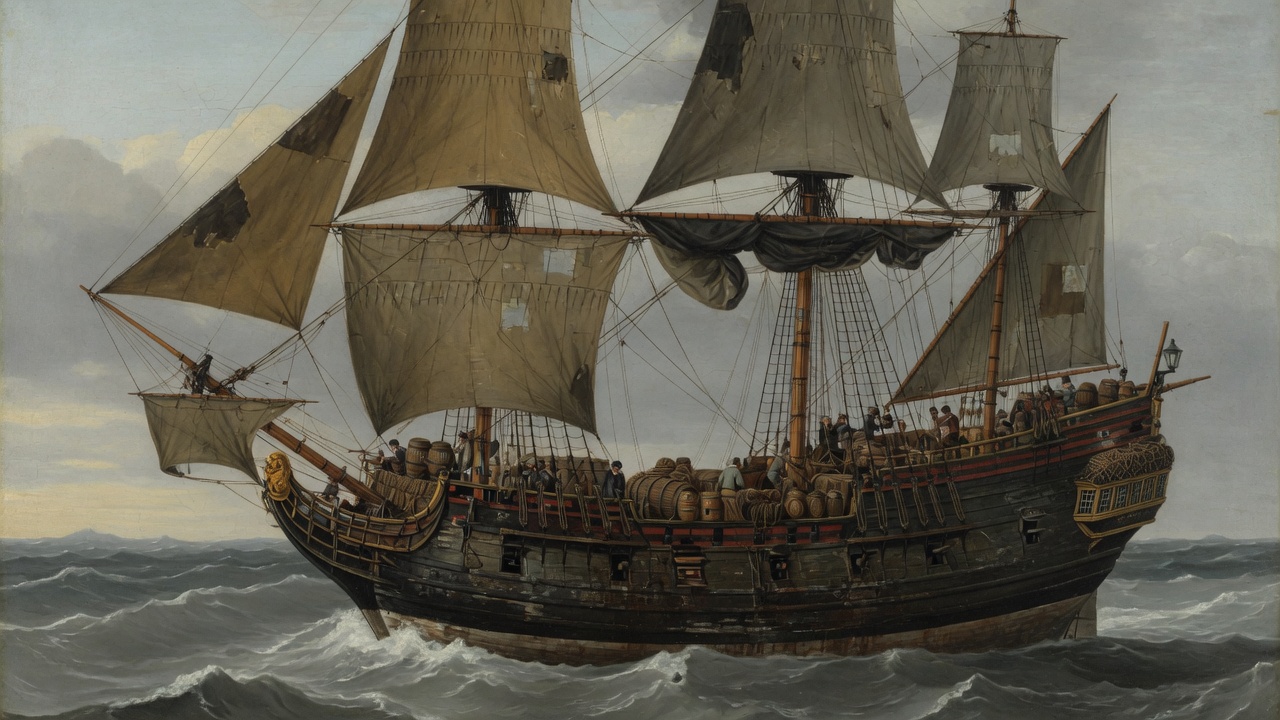
The Albaugh line is the earliest crossing in the record, though Haddie Albaugh's own descent from Zachariah Ahlbach has not yet been traced generation by generation. Palatine families in the 1730s usually went down the Rhine to Rotterdam, then into the North Sea and across to Philadelphia, then the busiest German Protestant port in British America. A Rotterdam–Philadelphia sailing in that decade commonly took six to twelve weeks, longer if the ship waited for a convoy or lost the wind. Steerage was crowded; illness was ordinary. The Hope Galley is the name this archive preserves. The family then settled in New Jersey and Maryland. That Atlantic crossing is the only ocean voyage required for this line. Everything after it in the record is overland: Pennsylvania, Ohio, Indiana, West Virginia, Michigan.
1840s–1860s — Tiree to Bruce County, Canada
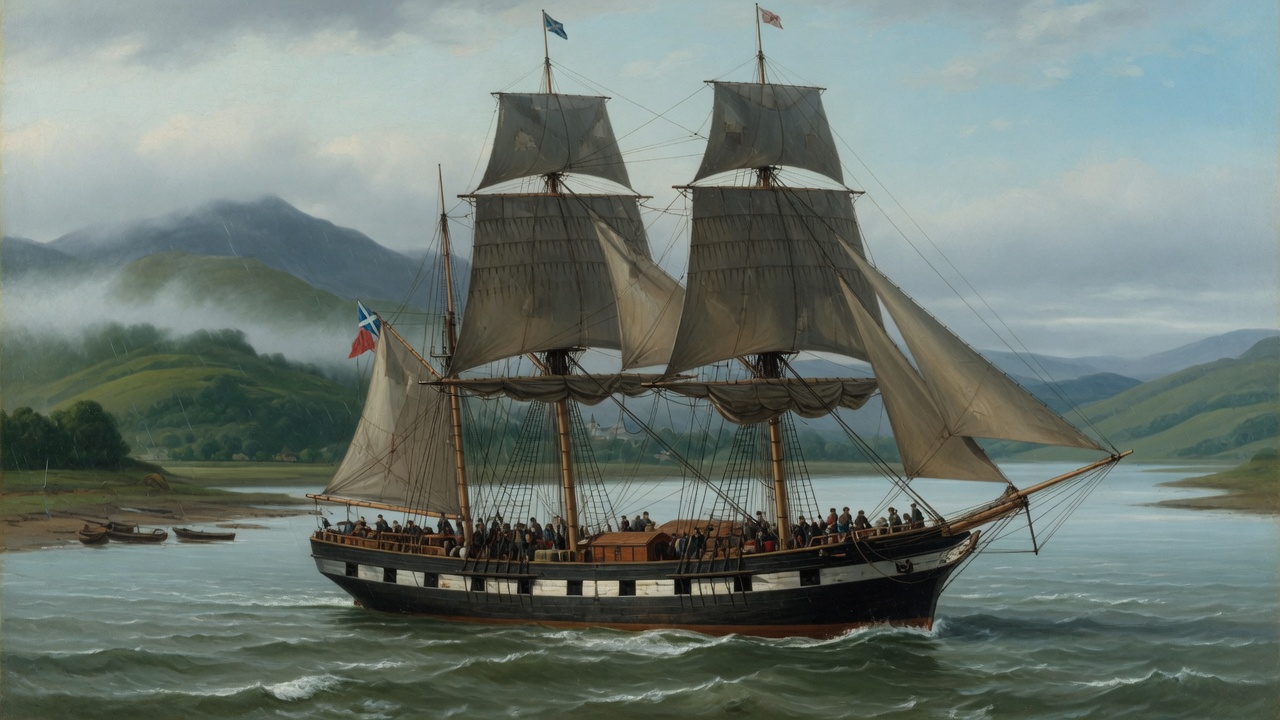
Neil McKinnon was born on Tiree in 1827. His son John was born in Bruce County, Ontario, in 1868. The ocean crossing sits between those two facts, most likely in the late 1840s or 1850s, the years of Highland and Hebridean emigration after the potato failures. Hebridean families did not sail from Tiree to New York. The usual path was a small boat to Tobermory or Oban, then Greenock or Glasgow, then a timber or emigrant ship down the Clyde and across to Quebec. From the St. Lawrence they went inland toward the Great Lakes and, for this family, Bruce Township. In the 1840s many of those Atlantic legs were still sail, often four to eight weeks. By the late 1850s steam was common on the main Canadian run, cutting the ocean to about two weeks. Janet McLaren, born in Perthshire, also had to cross; whether she sailed with Neil or met him in Ontario is not yet in the record. Neil's gravestone says "Native of Tiree", and his father Archibald, buried beside him, was also a native of Tiree who died in Bruce County in 1866. No Archibald-and-Neil household appears in the 1841 or 1851 Tiree censuses, so the family may have crossed before the famine-era wave described here. A different Neil McKinnon, christened on Tiree in 1827 to Donald McKinnon and Christina McFarlane, emigrated about 1850 and became a minister in Middlesex County; FamilySearch's tree merges the two. This line reached Michigan only later, by land, when Catherine MacKinnon married Lloyd Hartle.
After 1832 — Midlands England to New York
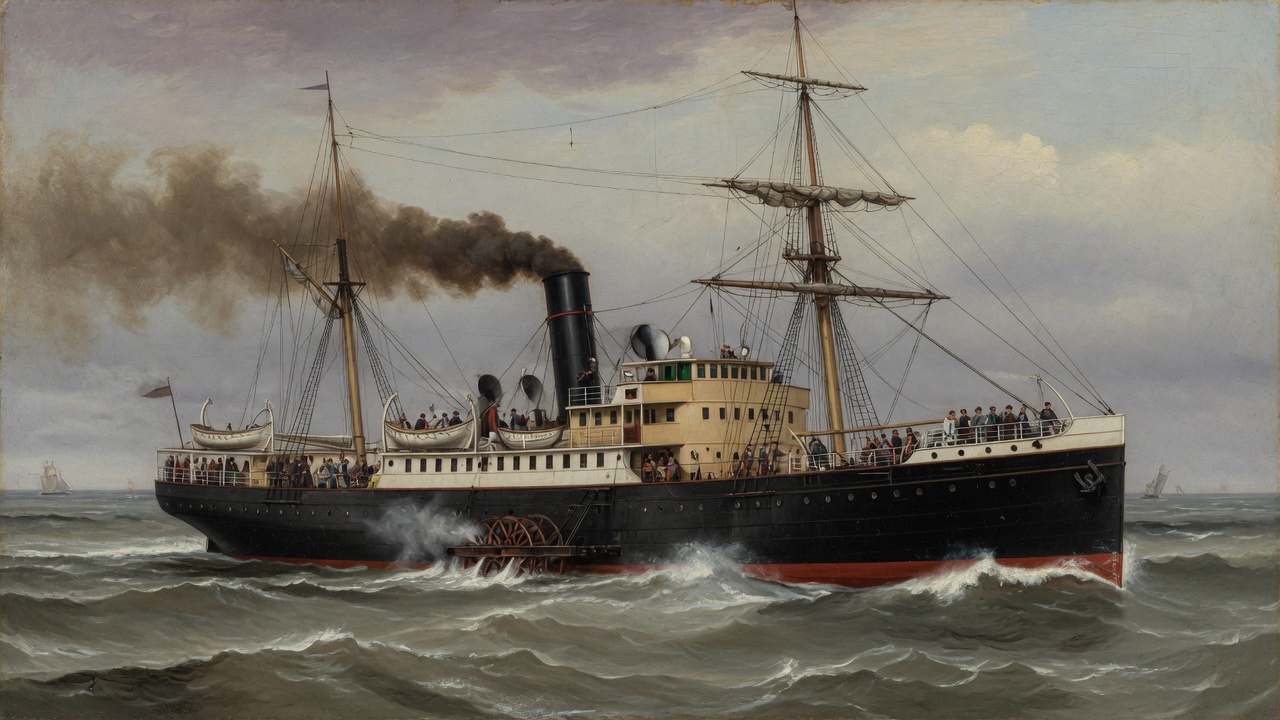
Thomas Derry Jr. was born in Cambridgeshire on 26 January 1832 (family records say Fen Drayton; the printed sources do not name the village). His father, Thomas Derry Sr., born at Lichfield in 1808, died in New York in 1866. Albert M. Derry was born in New York. So the family left England after 1832 and was in New York before 1866. A county history says Thomas Jr. emigrated with his parents in 1854 and settled in Wayne County, New York; a descendant's note names the ship Quickstep, London, 17 May 1854, which is unconfirmed. English farm families in those decades usually went overland or by canal and rail to Liverpool, then steerage to New York. In the 1840s that was still often a sailing packet, four to six weeks. From 1840 Cunard and then other steam lines ran Liverpool to Halifax, Boston, and New York; by the 1850s–1860s a steam crossing was commonly ten to fourteen days. An 1854 crossing could be sail or steam; no passenger list has been found. Thomas Sr. died in New York; Michigan comes later, with Thomas Jr. and then Ernest, born in Michigan in 1886.
1800s — England to Ontario (Hartle)
The Hartle surname is English. The first firm North American home in this archive is Collingwood, Ontario, in the 1860s–1900s. The Atlantic crossing itself is not dated. English emigrants bound for Upper Canada in the mid-nineteenth century typically left Liverpool or London for Quebec, then went upriver. That is a Canadian landing, not a U.S. one. Lloyd Hartle was born in Collingwood in 1903; the move into Michigan is twentieth-century and inland.
What to look for next
The highest-value documents are still missing: a passenger list or naturalization for Thomas Derry Sr.; a Quebec or Ontario arrival for Neil McKinnon and Janet McLaren; and a Hartle sailing to Canada. Philadelphia German lists for 1734 can be checked against the Hope Galley entry already in this archive. Until those papers are in hand, the map shows homes. This essay shows how people of those years usually got from one shore to the other.